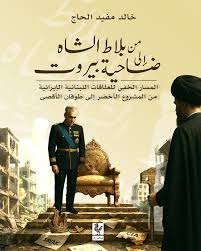
From the Shah's Court to Beirut's Suburb
A documented historical study of Lebanon-Iran relations, tracing the evolution of political, security, economic, and cultural ties across decades of regional transformation.
This work offers a deeply researched historical account of the Lebanese-Iranian relationship, moving beyond simplified political narratives to examine the layered development of influence, alliance, strategy, and regional interaction. Drawing on archival material, primary documentation, and a broad historical framework, the book reconstructs how this relationship was formed, expanded, and reshaped through major turning points in modern Middle Eastern history.
Rather than treating Lebanon-Iran ties as a purely contemporary political issue, the book situates them within a longer historical continuum—from the era of the Shah, through the Islamic Revolution, and into the complex realities of Beirut’s modern political and strategic landscape. It highlights the institutional, geopolitical, and ideological dimensions that shaped the relationship and explains how these developments influenced Lebanon, Iran, and the wider region.
Document-Based Research
A study grounded in archival sources, documentary evidence, and historical analysis.
Multi-Dimensional Scope
Covers political, strategic, economic, security, and cultural dimensions of the relationship.
Strategic Historical Value
Designed for researchers, policymakers, analysts, and readers of Middle East affairs.
Why This Book Matters
In a region shaped by hidden alignments, shifting alliances, and long-term strategic calculations, understanding Lebanon-Iran relations requires more than commentary—it requires historical depth. This book aims to provide that depth by combining rigorous documentation with a structured analytical approach, enabling the reader to grasp not only what happened, but why it happened, and how its consequences continue to shape the present.
It is both a historical record and an interpretive framework: a work that seeks to illuminate one of the most consequential relationships in modern Levantine and regional politics.